
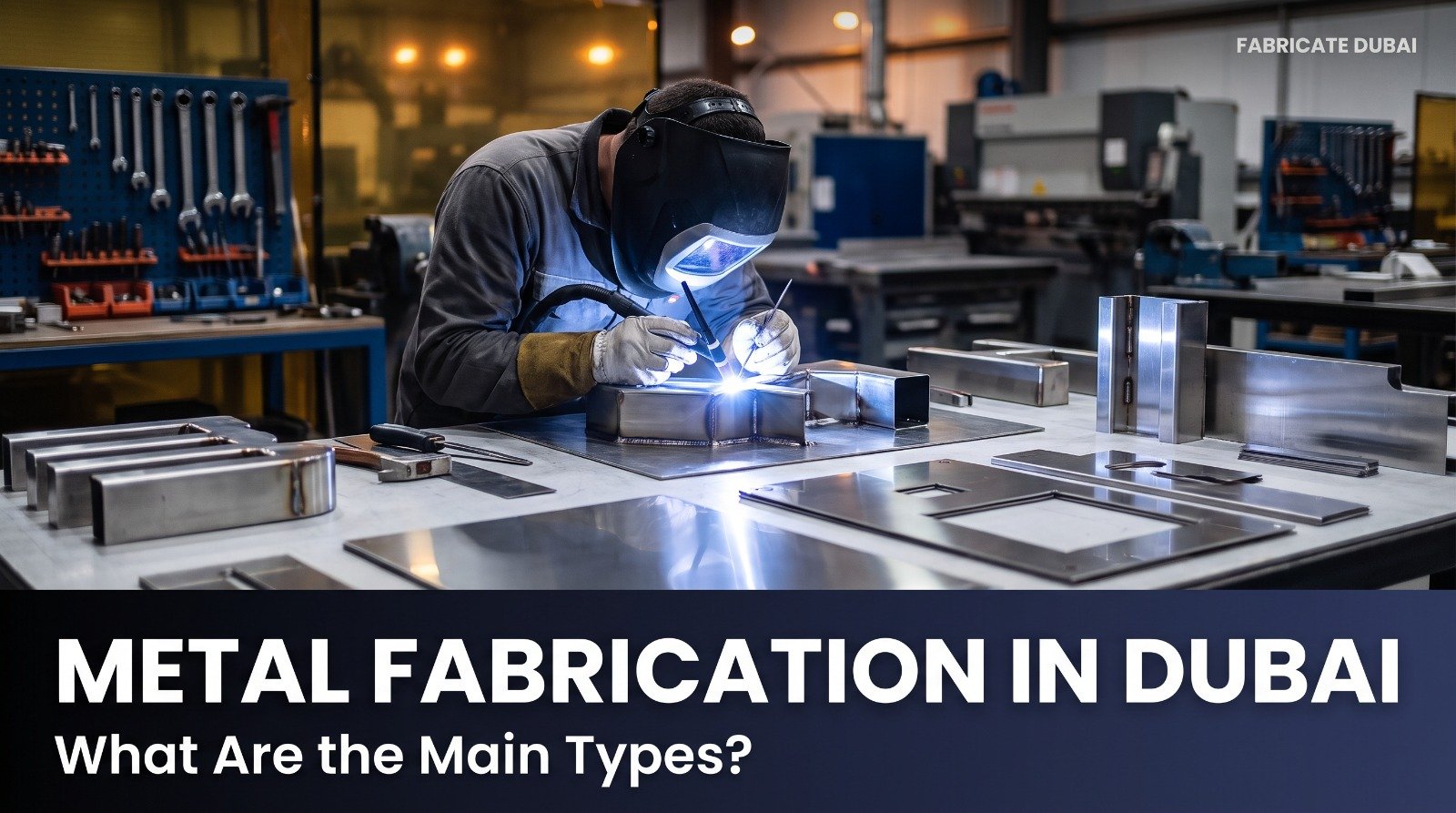
Walk through any commercial district in Dubai — from the retail strips of Business Bay to the corporate towers of DIFC — and the quality of metal fabrication is immediately visible. The precision of a stainless steel reception counter. The clean weld lines on a channel letter sign. The powder-coated aluminum extrusions of a shopfront display system. Each of these represents a specific type of metal fabrication — a distinct process with its own equipment, expertise, and application range.
Metal fabrication in Dubai covers a broad range of industrial and commercial processes. Understanding the main types helps businesses brief suppliers correctly, evaluate proposals accurately, and understand why certain applications cost more than others. Here is a plain guide to the types used across Dubai’s signage, retail, construction, and hospitality sectors.
The Main Types of Metal Fabrication in Dubai
1. CNC Cutting and Routing
CNC — Computer Numerical Control — cutting uses digitally programmed machines to cut metal sheet material with precision that manual cutting cannot achieve. In Dubai’s commercial fabrication sector, CNC cutting is the standard process for producing flat metal components — letter forms for signage, decorative panels, and structural parts that require consistent, repeatable dimensions.
CNC plasma cutting handles thicker steel and aluminum sections — from 3mm up to 25mm or more — producing clean cuts at high speed. CNC routing handles thinner sheet materials and produces finer detail. Furthermore, CNC waterjet cutting handles materials that cannot tolerate the heat generated by plasma — including certain stainless steel grades where heat-affected zones would compromise the surface finish.
The precision of CNC cutting directly affects the quality of the finished fabrication. Components that fit together accurately at the cutting stage require less adjustment at assembly — reducing production time and improving the consistency of the finished result.
2. Laser Cutting
Laser cutting uses a focused high-power laser beam to cut metal sheet with exceptional precision and edge quality. In Dubai’s fabrication market, laser cutting is the specified process for work requiring fine detail, tight tolerances, and clean edges without secondary finishing — particularly for stainless steel signage components, decorative architectural elements, and precision-cut display fixtures.
The edge quality of laser-cut stainless steel is significantly better than plasma-cut equivalents. Consequently, laser cutting is the standard specification for any visible metal component in high-end retail fabrication, hospitality environments, and premium corporate installations across Dubai where the cut edge is part of the finished visual.
Laser cutting is more expensive than plasma cutting for equivalent thicknesses — but for applications where edge quality is critical, it eliminates the secondary finishing work that plasma-cut edges require. Additionally, laser cutting handles intricate patterns and fine perforations that plasma cannot produce.
3. Metal Bending and Forming
Metal bending uses press brakes — large machines that apply controlled force to bend sheet metal at precise angles — to create three-dimensional forms from flat metal sheet. Forming extends this into more complex three-dimensional shapes using rolls, presses, and specialist tooling.
In Dubai’s fabrication sector, bending and forming are used extensively in retail fabrication — shopfitting counters, display plinths, shelf brackets, and structural frames that make up the built environment of commercial interiors. Furthermore, signage channel letter forms — the aluminum or steel returns that give three-dimensional letters their depth — are produced through bending processes on specialist letter bending machines.
The quality of bending work is visible in the finished installation. Consistent bend angles, tight corner radii, and accurate dimensions across multiple identical components are the indicators of quality press brake work. Inconsistent bending — visible as uneven angles or dimensions that vary between components — creates fitting problems at the installation stage that are expensive to correct.
4. Welding and Joining
Welding joins metal components by melting the material at the join point — either with or without a filler metal — to create a bond that, when done correctly, is as strong as the parent metal itself. In Dubai’s commercial fabrication market, MIG welding, TIG welding, and spot welding are the three most commonly used processes.
MIG welding is the standard production welding process for structural fabrication — fast, versatile, and capable of handling a wide range of metal types and thicknesses. It is used for structural frames, brackets, and fabricated assemblies in retail fabrication, construction, and industrial applications across Dubai.
TIG welding produces significantly higher quality welds with finer control over the heat input and the weld bead. Consequently, TIG welding is specified for stainless steel signage components, architectural metalwork, and any fabrication where the weld will be visible in the finished installation. A quality TIG weld on stainless steel, ground and polished correctly, is essentially invisible in the finished surface.
Spot welding joins thin sheet metal components at specific points using electrical resistance heating. It is used in the production of sheet metal enclosures, display fixtures, and light structural components where continuous welds are not required.
5. Surface Treatment — Powder Coating and Finishing
Surface treatment is not a fabrication process in isolation — it is the final stage that determines the appearance and durability of the finished metal component. In Dubai’s fabrication market, powder coating is the dominant surface treatment for aluminium and mild steel components that will be painted or colour-finished.
Powder coating applies a dry powder electrostatically to the metal surface and then cures it in an oven — producing a hard, durable, consistent finish that is significantly more resistant to chipping, scratching, and UV degradation than liquid paint. Furthermore, powder coating is available in any RAL colour and in a range of surface textures — gloss, satin, matte, and textured finishes — giving Dubai’s retail fabrication sector complete colour flexibility within the coating system.
For stainless steel components, surface treatment takes different forms. Brushed finishing — grinding the surface with progressively finer abrasives to create a consistent linear grain — is the standard premium finish for stainless steel in Dubai’s retail, hospitality, and corporate fabrication market. Mirror polishing, satin finishing, and PVD (Physical Vapour Deposition) colour coating are used for higher-specification applications.
6. Structural Steel Fabrication
Structural steel fabrication involves the production of load-bearing steel frameworks — columns, beams, trusses, and structural connections — used in building construction, industrial installations, and large-scale commercial fit-outs across Dubai.
In Dubai’s active construction market, structural steel fabrication supports the full range of building types — from retail mall infrastructure to industrial warehouses in Jebel Ali and Dubai Industrial City. Furthermore, exhibition stand construction at Dubai’s major venues uses structural steel fabrication for the large custom-built display structures that require engineered load-bearing frameworks rather than lightweight modular systems.
How Metal Fabrication Types Work Together in Dubai Projects
Most commercial projects in Dubai involve multiple fabrication types working in sequence — not a single process in isolation. A retail fabrication project for a Dubai shopfront illustrates this clearly.
The channel letter sign components are laser-cut for edge quality. The letter returns are bent to the correct profile on a letter bending machine. The components are TIG-welded together. LED strips are fitted inside each letter form. The finished letters are powder-coated to the brand’s RAL colour specification. The mounting framework is MIG-welded from steel section and powder-coated to match. Finally, the complete installation is fixed to the building facade by the installation team.
Each type of fabrication contributes to the finished result — and the quality of each process is visible in the quality of the installation. Consequently, choosing a fabrication partner in Dubai who handles all these processes in-house — rather than outsourcing between multiple subcontractors — gives better quality control and more direct accountability for the finished result.
